Tell me what you want what you really really want....
Your Story
Throughout my sexuality education career, I experience the same thing: people want to tell me their deepest darkest secrets and never are those stories about the good things.
Nope, not "my orgasms are amazing!" ... not "I love my body"
... not "I'm looking forward to experiencing menopause"
... not "my boundaries were respected".
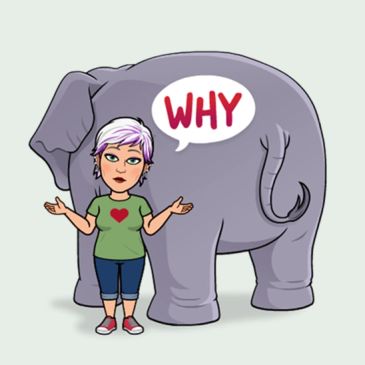
I hear a steady stream of angsty, agitated, angry, and agrieved heaviness. Well, bad things do happen to good people and WHY don't we have more positives with human sexuality??
Frankly, I'm tired of it. Not because I don't understand the need to piss, moan, and process but because these are intelligent, capable, resilient, and sassy folx who have been clearly misinformed and are grossly uninformed and haven't found the right space to unleash and learn.
I can do something to help!
prevention to postvention, let's do some high quality sex ed.
My Story
Our time together may not be smooth. You may feel the feelz
(the good, the bad, and the ugly)...
...however, I promise to teach in a manner that facilitates your
eyes-wide-open enthusiasm
while you connect your dots.
I love my work. And I truly get excited when the science clicks and your random dots coalesce and
the pieces start fitting together.
See what I did there?
Moving It Forward
Moving It Forward
Tell Me What You Want. What You Really, Really Want.
About sex. Sexuality. Bodies. Relationships. Identity. Pleasure. Health. Growing up. Growing older. Being a human with other humans.
Tell me what you want people to know, understand, talk about, wrestle with, or do differently — and I’ll build the education to get us there.
A lesson plan? Yep.
A two-hour workshop? Absolutely.
Professional development for people who work with actual humans? One of my favorite things.
A multi-session training series? Let’s go.
An entire curriculum? Been there. Done that. Have the evaluation data.
Because here's the thing:
I teach about being human.
And being human comes with a LOT of material.
For more than three decades, I’ve created and facilitated sexuality education for youth, adults, educators, health professionals, social service providers, community organizations, and plenty of folx who walked into the room thinking,
Oh dear God, what is she going to make us talk about?
Turns out, quite a bit.
Sex/ual/ity Education 101 — What do people actually need to know, and when do they need to know it?
Know Your Bits — Accurate anatomy, body literacy, and ditching the shame we were handed.
Hot, Bothered, & Brilliant: The Science + Survival of Menopause — Hormones, hot flashes, changing bodies, sexuality, and thriving through the whole damn thing.
Rolling in the Deep: Navigating Sexual Health & Wellness in Curricula and the Classroom — Helping educators get comfortable, competent, and credible when sex/ual/ity walks into the room. Because it will.
From Margins to Belonging: Building Real Support for Q+ Youth — Moving beyond performative inclusion toward environments where young people actually experience belonging.
Visible & Resilient in Community and Self — Identity, autonomy, empathy, voice, communication, relationships, coping, connection, resilience, and prevention.
SOGIE 101 & 201 — Sexual orientation, gender identity and expression — from foundational understanding to putting knowledge into practice.
Sexuality + Sexual Violence Prevention — Because accurate, age-appropriate sexuality education is prevention education.
Bodies, Boundaries & Consent — Understanding autonomy, communication, power, respect, and what consent actually requires.
Puberty, Hormones & the Endocrine System — What the hell is happening to my body — and WHY?
Relationships, Communication & Connection — Because knowing how bodies work is useful; knowing how humans work together is essential.
And then there are the workshops that don’t have names yet.
Those might be my favorite.
Bring me the population.
Bring me the problem.
Bring me the uncomfortable question everybody keeps dancing around. Bring me the thing your staff, students, clients, parents, patients, educators, or community members need to understand but nobody quite knows how to teach.
We’ll figure out what they need to know, what they need to think about, what they need to practice, and what they should be able to do differently when they leave.
Then I’ll build it.
Medically accurate.
Research-informed.
Developmentally appropriate.
Person-centered.
Culturally responsive.
Sex-positive.
Trauma- and healing-centered.
Interactive.
Practical.
And — this matters — human.
Because sexuality education isn't simply about sex. It’s about bodies and boundaries. Identity and relationships. Power and pleasure. Communication and consent. Health and harm reduction. Growing up and growing older. Belonging. Agency. Resilience. Justice. It’s about how we understand ourselves and how we live alongside one another.
That’s what I teach. So...
Tell me what you want. What you really, really want people to learn.
And let’s build something.
